It's difficult to believe how long ago it was that I left Texas to study for a semester in Spain. It'll be three years ago next month that I returned. Since then, I graduated college, moved to Houston, started medical school, and married the beautiful woman who put up with four months of trans-Atlantic dating for me.
I set out with the best intentions for this blog. It would be part travelogue, part mini-course on Spanish language, literature, and culture. But the burden of keeping up with the blog started to take away from time experiencing Spain and it fell into neglect. I wasn't exactly making a living blogging so its abrupt end probably went unnoticed by all save my immediate family and a handful of others. I thought about it from time to time, about how I needed to at least make a post explaining that I wasn't going to be blogging anymore if for nothing else than a sense of closure. I just never got around to it.
What made me log back on today for the first time in years was watching the series The Long Way Round on Netflix. It chronicles Ewan McGregor and his friend as they travel around the world on their motorcycles. It's a fascinating show that I highly recommend. In one of the scenes, they're getting an impromptu tour of an old Soviet coal mine by some probable mobsters in Ukraine. They hold up a nugget of coal to prove that, yes, it's a real coal mine. Go figure. I thought, "well that would be a neat souvenir." And then considered the problem of collecting physical objects during such a trip with limited space.
I don't get philosophical much anymore (those days spent talking about nothing at all for course credit are behind me, for better or worse), but I considered the idea that the best possible souvenir they could have from this trip is this series that keeps their memories of their journey so sharp in their minds. My parents were the first ones to point out to me that when you take a trip, you're not really paying for the trip itself; you're paying for the memories. Any time I want, I can go back to Spain, or Alaska, or Boston, or any of the wonderful places I've been lucky enough to see over the years.
Which brings me back to this blog. Although I hope that a few of you have gotten some enjoyment out of reading about the things I did in Spain, I've realized that it wasn't ever really for y'all. It was to keep my experiences sharp in my own mind, so that I could revisit them any time I wanted.
Although I had many more great times in Spain during the few months I was there beyond the end of this blog, what I really want to do over the next few days is chronicle a side trip that I took over Holy Week with two buddies of mine. In a lot of ways, it was my own Long Way Round. A few of us taking a ridiculously ambitious trip through a continent that we didn't know with a travel plan that we were told in unequivocal terms was crazy and would likely get us killed. But what a journey it was. We didn't have the luxury of a full time camera crew and production staff to record our journey, but I do have several pages of notes from the trip that I've kept in my backpack for the last three years. It's time that I make them a bit more permanent.
So with that, I hope that those of you reading will get some enjoyment out of these next few posts. I know I will.
Tuesday, April 8, 2014

Excursion to Madrid pt. III
From Toledo, we drove straight through Madrid to Segovia, a small medieval town in the mountains just outside of the capital. The main thing the school was concerned with us seeing here was the incredible Roman aqueduct, which is one of the most significant Roman remnants on the Iberian peninsula. And indeed, it was impressive. Too big to get into one picture, but a quick Google search will give you a good idea about the immensity of the structure.
Although the aqueduct is the most significant thing in Segovia from an historical and educational standpoint, what I was most looking forward to was the legendary restaurant right next to it, El Meson de Candido, and its specialty: roast suckling pig. The pigs are roasted whole, with some of the entrails removed (but not all-- I stumbled upon a kidney in my section). Traditionally, Candido himself comes out with the pigs arranged on platters, cuts them into sections using a dinner plate, makes a speech, and smashes the plate. The other room got to see this, but alas, I guess they were running low on plates that day and our room didn't get the pleasure. What we DID get, however, was one of the top five meals of my life.

Hunter, shown in the picture, and I ordered the suckling pig. My other two friends at the table ordered baby goat, which was also quite good. But you just can't beat roast baby pig. Crispy skin, tender, juicy meat. Paired with a good house wine and followed by the best dessert I've ever had (the "house special dessert", which I later found out is also know as a segoviano) and a fantastic cafe con leche, and there you have it. The atmosphere was great too. The inn (meson means inn in Spanish) has been around since the 1700's, and Candido, who ran it for sixty years before he died in the 1990's, became a legend of Segovia. He was officially recognized by the king as being "the greatest inn-keeper in all of Castilla-Leon", which is the autonomous community (like a state) in which the inn is located. We didn't realize it until towards the end when we got commemorative pamphlets that his son, also named Candido, had been our waiter the whole time! Naturally we went and asked him if we could get a picture with him. "A picture? No. Many pictures!" was his reply.
 The purple sash he's wearing is an honor bestowed upon him by the king. Such a nice guy. If I ever come back to Segovia, Candido's will be my first stop. Because we spent so much time eating (true Spanish form), we barely had any time to check out Segovia's other major attraction: the Alcázar of Segovia, perhaps better known to Americans as the castle that inspired the Disney castle.
After jogging through the castle (great views of the surrounding countryside and cool sets of armor), we made it back to the bus just in time.
From Segovia, we finally went to Madrid, where we checked into our hotel. We had been given a list of possible things to see in Madrid, since there were no required group outings. Along with the list of sites to see, we got a list of restaurants we might be interested in. We decided to try one of them, El Rey de los Tallarines, or "Noodle King", that night. Some might criticize us for eating Chinese food in Madrid, but one has to remember that we'd been eating Spanish food for two and a half months at this point, and anyway this restaurant hand makes their noodles, which is something I wanted to see. Didn't disappoint. Plate of noodles for less than ten euro, can't beat it with a stick.
 Y'all are probably sick of hearing about food, but I'm hungry at the moment and we had some fantastic food on this trip. The next morning, we headed to el Mercado de San Miguel, which some of you may remember from the post about my first day in Spain.
 We snacked and bought some food for later in the day. Earlier when I said that all our time in Madrid was free, well, that was true as far as it went. But during our first full day in Madrid, we took an excursion to another town to see El Escorial, one of Spain's largest palaces, and a popular day trip from the capital.
 The palace is much too large to get into one shot with my camera. Here's a distant view of the place I found on the internet to give you an idea of the size:

Despite its outer grandeur, however, the inside is really pretty austere as palaces go. In addition to serving as a royal residence, it is also the tomb of every Spanish monarch, save two, since the 1500's. The twenty-six marble tombs line the walls of a circular room inside the palace. Pictures were forbidden, but I managed to get a shot inside.
 Bad picture, but there was a guide watching us and it was dark, and of course I couldn't use a flash. Impressive place, but I was really looking forward to getting back to exploring Madrid.
The next day was our only full day of free time in Madrid, as we were due to take the Ave (Spain's high-speed train) to Sevilla the next morning. So, we started bright and early with the Palacio Real, Spain's answer to Buckingham Palace.

Although the aqueduct is the most significant thing in Segovia from an historical and educational standpoint, what I was most looking forward to was the legendary restaurant right next to it, El Meson de Candido, and its specialty: roast suckling pig. The pigs are roasted whole, with some of the entrails removed (but not all-- I stumbled upon a kidney in my section). Traditionally, Candido himself comes out with the pigs arranged on platters, cuts them into sections using a dinner plate, makes a speech, and smashes the plate. The other room got to see this, but alas, I guess they were running low on plates that day and our room didn't get the pleasure. What we DID get, however, was one of the top five meals of my life.

Hunter, shown in the picture, and I ordered the suckling pig. My other two friends at the table ordered baby goat, which was also quite good. But you just can't beat roast baby pig. Crispy skin, tender, juicy meat. Paired with a good house wine and followed by the best dessert I've ever had (the "house special dessert", which I later found out is also know as a segoviano) and a fantastic cafe con leche, and there you have it. The atmosphere was great too. The inn (meson means inn in Spanish) has been around since the 1700's, and Candido, who ran it for sixty years before he died in the 1990's, became a legend of Segovia. He was officially recognized by the king as being "the greatest inn-keeper in all of Castilla-Leon", which is the autonomous community (like a state) in which the inn is located. We didn't realize it until towards the end when we got commemorative pamphlets that his son, also named Candido, had been our waiter the whole time! Naturally we went and asked him if we could get a picture with him. "A picture? No. Many pictures!" was his reply.

 |
| Source: http://en.wikipedia.org/wiki/File:Exterior_Alcazar_Segovia.jpg |
From Segovia, we finally went to Madrid, where we checked into our hotel. We had been given a list of possible things to see in Madrid, since there were no required group outings. Along with the list of sites to see, we got a list of restaurants we might be interested in. We decided to try one of them, El Rey de los Tallarines, or "Noodle King", that night. Some might criticize us for eating Chinese food in Madrid, but one has to remember that we'd been eating Spanish food for two and a half months at this point, and anyway this restaurant hand makes their noodles, which is something I wanted to see. Didn't disappoint. Plate of noodles for less than ten euro, can't beat it with a stick.


Despite its outer grandeur, however, the inside is really pretty austere as palaces go. In addition to serving as a royal residence, it is also the tomb of every Spanish monarch, save two, since the 1500's. The twenty-six marble tombs line the walls of a circular room inside the palace. Pictures were forbidden, but I managed to get a shot inside.

The next day was our only full day of free time in Madrid, as we were due to take the Ave (Spain's high-speed train) to Sevilla the next morning. So, we started bright and early with the Palacio Real, Spain's answer to Buckingham Palace.

Tuesday, April 12, 2011
Stopover in Toledo (Excursion to Madrid pt. II)
Our first night of the excursion was spent in the town of Toledo, just south of Madrid. Like most cities in Spain, Toledo is old. Really old. Thought to be populated since the 7th century BC, it rose to fame particularly during the Reconquista (the period of constant war in which the Christians "reconquered" Spain from the Moors) for its guilds. By the 17th century, Toledo steel and swords came to be considered the best in all of Europe. I was excited to check out the sword shops during the few hours we had there that evening. I have to admit that I was disappointed, however. It's been a long time since Toledo has been making actual swords, and it shows in the sheer amount of cheesy crap that fills just about every "sword" shop there. For one, nearly all of the swords that are now sold in Toledo aren't made in Toledo, but rather in Madrid or, worse, China. Not only that, but these swords aren't actually forged any more, but rather are stamped pieces of steel (despite what any of the shop owners will tell you). And most of the swords are gimmicky movie replicas (Lord of the Rings swords are everywhere). We did manage, however, to find a shop that had a basement with real, forged, handmade swords. The cheapest one we saw was around 350 euros, which is about 300 euros more than I'm willing to spend on a sword. It was still cool to see, though.
Regardless of the gimmicky souvenirs that one can find there, Toledo really is a neat city. Its narrow, winding, cobbled stone streets makes the city feel its age. Sevilla is a wonderful place, but you definitely feel like you're in a big city. Toledo, which is much smaller than Sevilla, has kept that medieval charm.
But enough with streets and swords, what we were interested in was its famous dessert: marzipan. Behold:
 I don't remember what this particular piece of heaven was called, but it was, well, heavenly. Marzipan, cream, and cake. Phenomenally good. Marzipan is basically sugar and almonds, made into a paste and then cooked to harden. We ended up going back to this shop four times that evening.
The next morning I woke up early for another unique-to-Toledo experience: the Mozarabic Mass. During the Moorish reign, the Christians residing in Toledo that didn't convert to Islam were allowed to continue holding Mass. Because they were isolated from the broader Christian community, their particular rite evolved distinctly to the rest of the world. The result was the Mozarabic Rite (Mozarab is the word for a Christian who lived under Moorish rule), which is preserved today in Toledo. Toledo, as it were, is the only place in the world with the permission of Rome to practice this Mass. The Mass was conducted in Latin, with long pauses for chanting, which was provided by a choir that I would imagine only does this liturgy. A fascinating experience. Afterward, we were free to explore the Cathedral of Toledo, which is stunning:
 Unfortunately, we didn't get very long to wander around, as we were already late for the only group sight of the city: El Greco's painting The Burial of the Count of Orgaz, which was painted for, and still located in, a small church nearby.
Naturally, we weren't allowed to take pictures inside. But the painting itself was absolutely magnificent. There are times when you see a painting on posters and books, then see the real thing and are disappointed. Seeing this painting, which I first studied in high school, was the exact opposite experience.
 While an impressive painting in pictures, the real thing is breathtaking. The colors are remarkably vivid, as if they were painted yesterday. There's something else about El Greco's style that I find intriguing, but I can't quite put my finger on it. Anyway, the Count of Orgaz, who is depicted in the painting being laid into his tomb, was Don Gonzalo Ruíz, a wealthy and very pious native of Toledo. According to legend, his piety was such that when he died, Sts. Stephen and Augustine came down from heaven to bury him with their own hands (they are the two figures dressed in gold at the bottom). The bottom of the painting, which has a darker tone than the top, is set in the mortal world; the top, the celestial. Although you can't see it in the picture above, El Greco actually depicts the man's soul being ushered into heaven, at the apex of the triangle formed in the middle of the painting. Books have been written on this sort of thing, so I won't delve any deeper. But it doesn't matter. One doesn't need to know the story or the analysis of this painting to recognize its brilliance.
All too soon, it was time to leave Toledo. There were a lot of things to see this excursion and although I could've spent several days in that city alone, we had to be moving on.
Regardless of the gimmicky souvenirs that one can find there, Toledo really is a neat city. Its narrow, winding, cobbled stone streets makes the city feel its age. Sevilla is a wonderful place, but you definitely feel like you're in a big city. Toledo, which is much smaller than Sevilla, has kept that medieval charm.
But enough with streets and swords, what we were interested in was its famous dessert: marzipan. Behold:

The next morning I woke up early for another unique-to-Toledo experience: the Mozarabic Mass. During the Moorish reign, the Christians residing in Toledo that didn't convert to Islam were allowed to continue holding Mass. Because they were isolated from the broader Christian community, their particular rite evolved distinctly to the rest of the world. The result was the Mozarabic Rite (Mozarab is the word for a Christian who lived under Moorish rule), which is preserved today in Toledo. Toledo, as it were, is the only place in the world with the permission of Rome to practice this Mass. The Mass was conducted in Latin, with long pauses for chanting, which was provided by a choir that I would imagine only does this liturgy. A fascinating experience. Afterward, we were free to explore the Cathedral of Toledo, which is stunning:

Naturally, we weren't allowed to take pictures inside. But the painting itself was absolutely magnificent. There are times when you see a painting on posters and books, then see the real thing and are disappointed. Seeing this painting, which I first studied in high school, was the exact opposite experience.

All too soon, it was time to leave Toledo. There were a lot of things to see this excursion and although I could've spent several days in that city alone, we had to be moving on.
Saturday, April 9, 2011
An aside: Spanish WiFi
 |
| Pictured: Spain's Technology Minister |
Before I continue with the excursion, I’d like to comment briefly on one of my grievances with my second country. Free WiFi is almost remarkably difficult to find in Spain. Luckily, I have it at my host house, but if I want to go somewhere to do homework (I find it easier to concentrate in cafes) that requires internet, I’m in for an adventure. That’s because almost no place has WiFi. There are two main coffee chains here that are guaranteed to have it, however: Starbucks and a local chain called Café de Indias. But the internet at these places comes with a major catch; the code they give you when you make a purchase is only good for forty five minutes of internet. This is where I have a problem, on three main grounds:
First, this is a country, nay, a continent that is famous for not hurrying you once you sit down at a table in a restaurant. In the US, the waiters largely rely on tips for their living. Thus, lingering at restaurants after a meal without continuing to buy stuff is really looked down upon. Indeed, it’s not uncommon for a waiter to request that people leave if they’re taking up too much time at a table on a busy night. In Europe, however, I can go into a restaurant on the busiest night of the week, get a table, order nothing but a café con leche and sit there as long as I damn well please, without the waiter so much as giving me a second glance. Because here, once you sit down at a table, it’s yours for as long as you want it. The waiters here make decent salaries, and tips are not expected, so it makes no difference whatsoever to them how many tables they serve per night. The reason I bring this up is because I can already hear the responses I’ll get: “But Joe, if they didn’t limit the time, people would just sit there all day!” What difference does it make to them? Is my taking up a table to use internet (after making a purchase, of course) any different from a financial standpoint than taking up a table to read the paper/people watch/chat with friends/do nothing at all? Of course it isn’t.
Second, it’s not like they’re paying for internet by the minute. These aren’t long-distance phone calls we’re talking about here. Nor do they have a finite amount of internet. They don’t have an “internet cistern” in the back to collect internet when it rains kilobits. The internet isn’t going to run out. Nor does it cost more for more people to use. It’s greed, pure and simple.
Third, WiFi is not a new technology. It’s been around for years, which in technology time makes it an old, old innovation. For those of you rolling your eyes and reminiscing about a simpler time before there was internet and making a sarcastic comment about how unfortunate it is that I have to go without WiFi, consider first that I rely on the internet to research and turn in many of my assignments for class, as well as to keep in touch with family and friends back home. So there is a legitimate reason why I need it. Further, I think it’s a legitimate complaint to not have WiFi available at all times, wherever I am, for however long I need it, because this it’s the year 2011, people! Those who think I need to be less dependent on modern luxuries, would you think differently if I was complaining that all the restaurants and cafes here were un-air conditioned? Or required you to bring your own coffee cup, because they still hadn’t gotten around to adopting absurdly sophisticated technology of disposable cups? At some point, it’s reasonable to expect a certain level of available technology. I’m not asking for 4G connectability in the middle of the ocean. I’m asking (reasonably, I think) for a readily-providable customer accommodation in a developed, western country.
It seems fitting that at the end of this rant, I’ve discovered that my log-in information that they gave me at the register no longer works. I didn’t use forty-five minutes of internet. I used it as sparingly as one might use the last remnants of their heating oil in the dead of winter (which, as mentioned above, seems to be the Spaniards’ attitude toward internet anyway), getting on for five minutes then logging off for long stretches. I know I didn’t misunderstand the forty-five minute limit to mean that I could use as much internet as I wanted for forty-five minutes from the moment they generated that particular log in, either, because I was still able to get on an hour after they gave me the code. No, what seems to happen is that they put an arbitrary expiration time on the code (two hours, maybe) because internet kept in reserves goes rancid? Because they have to maintain the validity of the log-in information by burning large amounts of fossil fuel? Because their system can only keep up with three randomly-generated, time-sensitive codes at a time? To spite capitalists? Hell if I know their reasoning.
Wednesday, April 6, 2011
Ignored alarms, medieval castles, and Golden Age literature (Excursion to Madrid pt. I)
It was hard to believe that our last excursion as a group was already upon me. But such was the case on the morning of March 15th. Because of the drive we had ahead of us, we were told to be at the bus station at 6:30 in the morning-- sharp. We'd left behind late students on previous trips, so I wanted to make sure I got there on time. Because of a late night the day before, I decided to put off packing until the morning of. Factoring in the time it takes for me to pack, and that it takes roughly fifteen minutes to get to the train station (where we get on the bus) from where I live, I set my alarm for 5:30AM. More than enough time. Until I slept through my alarm. Well, sort of. I actually turned it off and went back to sleep without realizing it. When I woke up for the second time, I felt around my night stand for my cell phone (which I use as an alarm). When I didn't feel it there, I felt the beginnings of nervousness seeping through my veins. The only reason it's not there, I thought to myself, is because I've already woken up once and turned it off. If that's the case, then it should be somewhere here in bed with me, I continued. When I felt the shape of my phone underneath my pillow, I knew that I was in trouble. Knowing that I wasn't going to like what I was going to see, I looked at the time.
6:13AM
Keeping in mind the fifteen minutes it takes to get to the station, and that I wasn't even packed, I knew that this was about as close to being completely screwed as I could get. I jumped out of bed, threw everything that I could think of into my duffel bag, pulled on a pair of shoes (wearing the same socks I wore the day before and which I had slept in) and ran out the door. For the first tenth of a mile or so I did a sort of trail run maneuver, jogging along with my duffel bag and backpack pulling at my neck and shoulders. I quickly realized, however, that there were two main problems with this strategy. Number one, I'm not in good enough shape to jog the distance to the train station with that much stuff on me. Number two, even if I could somehow keep up a jogging pace for the entire way, I still wouldn't get there in time. I waved down the first taxi I saw and told him, "estación Santa Justa, pronto." The stars aligned and I got there just in time. My relief at making the bus was short lived, however; just as I sat down into my seat, I realized that I had forgotten something. I hadn't packed any socks. I was left with only the one-day-old pair that I was wearing. For a five day trip. Joy.
We were joined on this trip by a large number of family members. Because this is the longest excursion of the semester and it coincides with spring break in the United States, this has traditionally been the trip to take family and friends on. There are forty four students total here, along with three directors of the center, and three graduate teaching students. However, on that morning we set off with ninety-three people divided between two buses. Although my parents couldn't join us that week (they came a few weeks later, which will be a blog series in and of itself), it was still fun to hang out with everyone else's family. The more the merrier, but I have to say that the extra people, all of whom were on vacation (as opposed to the regular group who are here to study) made it feel like we were in one of those tacky, ubiquitous tour groups.
I've never been one for tour groups. For me, so much of the experience of traveling is experiencing a different culture. You can't experience a different culture if you create your own microcosm of Americans within a foreign country, which is essentially what a tour group is. It's a nucleus of people like you that's carefully carried from place to place to see selected sights, eat food that's almost always designed to not offend our American tastes, you take a some pictures with some living statues and are escorted to the airport. Indeed, one can spend weeks in a country without ever really experiencing anything. Of course, this is all just one guy's opinion. Millions of people every year (not just Americans; in Spain most of the tourists come from the UK) choose this path, and they enjoy their time. And that's fine-- it's much better than not traveling at all. It's just not for me.
Our first stop in this trip was at a castle called Calatrava La Nueva, a templar castle and monastery dating from the 13th century. Situated atop a steep hill, it offered fantastic views of the Castilla-La Mancha countryside.
The castle was designed to be completely self-contained. This would've been important because no matter how well fortified, by land and walls, a defense you have, you're completely helpless if your enemy cuts off your food/water supply. To that end, this fortification, which was in use until the 19th century, contained stables for cattle, a granary, and a well. Fortunately for the knights who lived here, the castle was never besieged.
After forty-five minutes of wandering around, everyone boarded the bus again to continue our drive north. Our next stop was the small town of Almagro, famous for Golden Age theater and pickled eggplant. The Siglo de Oro, or Golden Age of Spanish literature began in 1492 with the publication of the first book dedicated to the Spanish language, a grammar handbook by Antonio de Nebrija, and ended with the death of the last great writer of the period, Pedro Calderón de la Barca, in 1681.
(Author's note: For those who don't care for a mini-lecture about Spanish literature, feel free to skip ahead to the paragraph after the monologue)
Works from this period dominate the canon of literature studied by Spanish students. Don Quijote, Miguel de Cervantes' world-changing novel (the first and greatest modern novel, it is said) is the best-known work written during the Siglo de Oro, but Luis de Gongora, Francisco de Quevedo, Lope de Vega, and, already mentioned, Pedro Calderón de la Barca are also included among the literary giants of the era. The last one, Barca, is perhaps most famous for his play La vida es sueño, or "Life is a dream," which contains one of the most well-known monologues in all of Spanish theater. The play centers around Segismundo, a Polish prince who has been locked away in a tower for his entire life by his father, the king, due to a prophesy made before his birth that the new prince would someday overthrow the king. His imprisonment is the king's way of trying to escape fate (a popular theme in the day). The prince is not entirely alone, however; he has been educated over the years by a tutor who doubles as his jailer. One day, the king decides to do a little experiment in order to test the prophecy that his son would be a tyrant; he has Segismundo drugged and, in his induced sleep, has him carried to the royal palace and dressed as a king, with instructions to all persons present to treat him as if he had always been the king. His reasoning here is that he can always re-drug Segismundo and take him back to the tower and make him think that he dreamed the whole thing. When Segismundo wakes up, he is furious at realizing he has spent his entire life locked away instead of gaining his rightful inheritance. He takes his anger out on anyone who so much looks at him the wrong way-- in short, he acts like the tyrant the king feared he would become. True to the plan, he is redrugged and wakes up in shackles, as if nothing had ever changed. Naturally, this spurs some pretty hefty mental conflict. Was it all a dream? Could've been. But it felt so real. I think everyone who has ever had a dream that they swore was real could empathize. Segismundo's existential confusion is seen in his famous monologue, where he says that life itself is nothing but a dream. Kings are kings because that is what they dream. Likewise, beggars are only dreaming that they are poor. Segismundo concludes that he dreamt that he was a king, and now he's dreaming he's back in his tower:
Which takes us right back to Almagro. One of the city's main attractions, as I mentioned above, is its Golden Age theater.
This outdoor theater would've been the center of good times back in the day. Plays would run around four or five hours, including interruptions by the rowdy crowd that would've been standing around in the area directly in front of the stage (as opposed to the seated areas in the two balconies and around the ground floor). They'd usually do double features, meaning a full day of dramatic fun!
To conclude our visit, and to give us all an idea of what kind of stuff those riotous crowds would've been hearing, Dr. Scarborough, my literature professor, gave us a rousing interpretation of none other than the famous La vida es sueño monologue that I discussed above.
After the visit to the theater, we had an hour or so longer in the town to wander about and eat lunch before the last leg of driving for the day. As any of you who have read my previous posts know, I'm a big fan of eating. So naturally, I went to the first bar I saw to get some of their famous berenjenas (eggplant). The damn things were so messy, though, that I wasn't able to use my camera to take a picture of it. Enter stock picture:

They're stuffed with other vegetables, mainly tomato, and are served with a skewer of bamboo through them to keep them together. I know, I know, they really don't look like eggplants. I'm guessing that they're baby eggplants (hence the need to pickle them). They're quite good, tasting (I know this will come as a shock) like pickled vegetables-- more like okra than pickled cucumbers, though. For those of you wondering, yes. I do get paid by the word.
After my meal of pickled eggplant, I wandered around the impressive town square, stopping in its various shops to admire the hand-sewn lace which is a traditional craft of the area. Before long, we were back on the bus, headed to our final destination for the day: Toledo. But that will have to wait for my next post...
6:13AM
Keeping in mind the fifteen minutes it takes to get to the station, and that I wasn't even packed, I knew that this was about as close to being completely screwed as I could get. I jumped out of bed, threw everything that I could think of into my duffel bag, pulled on a pair of shoes (wearing the same socks I wore the day before and which I had slept in) and ran out the door. For the first tenth of a mile or so I did a sort of trail run maneuver, jogging along with my duffel bag and backpack pulling at my neck and shoulders. I quickly realized, however, that there were two main problems with this strategy. Number one, I'm not in good enough shape to jog the distance to the train station with that much stuff on me. Number two, even if I could somehow keep up a jogging pace for the entire way, I still wouldn't get there in time. I waved down the first taxi I saw and told him, "estación Santa Justa, pronto." The stars aligned and I got there just in time. My relief at making the bus was short lived, however; just as I sat down into my seat, I realized that I had forgotten something. I hadn't packed any socks. I was left with only the one-day-old pair that I was wearing. For a five day trip. Joy.
We were joined on this trip by a large number of family members. Because this is the longest excursion of the semester and it coincides with spring break in the United States, this has traditionally been the trip to take family and friends on. There are forty four students total here, along with three directors of the center, and three graduate teaching students. However, on that morning we set off with ninety-three people divided between two buses. Although my parents couldn't join us that week (they came a few weeks later, which will be a blog series in and of itself), it was still fun to hang out with everyone else's family. The more the merrier, but I have to say that the extra people, all of whom were on vacation (as opposed to the regular group who are here to study) made it feel like we were in one of those tacky, ubiquitous tour groups.
I've never been one for tour groups. For me, so much of the experience of traveling is experiencing a different culture. You can't experience a different culture if you create your own microcosm of Americans within a foreign country, which is essentially what a tour group is. It's a nucleus of people like you that's carefully carried from place to place to see selected sights, eat food that's almost always designed to not offend our American tastes, you take a some pictures with some living statues and are escorted to the airport. Indeed, one can spend weeks in a country without ever really experiencing anything. Of course, this is all just one guy's opinion. Millions of people every year (not just Americans; in Spain most of the tourists come from the UK) choose this path, and they enjoy their time. And that's fine-- it's much better than not traveling at all. It's just not for me.
Our first stop in this trip was at a castle called Calatrava La Nueva, a templar castle and monastery dating from the 13th century. Situated atop a steep hill, it offered fantastic views of the Castilla-La Mancha countryside.
 |
| View from an archery hole in one of the turrets. |
After forty-five minutes of wandering around, everyone boarded the bus again to continue our drive north. Our next stop was the small town of Almagro, famous for Golden Age theater and pickled eggplant. The Siglo de Oro, or Golden Age of Spanish literature began in 1492 with the publication of the first book dedicated to the Spanish language, a grammar handbook by Antonio de Nebrija, and ended with the death of the last great writer of the period, Pedro Calderón de la Barca, in 1681.
(Author's note: For those who don't care for a mini-lecture about Spanish literature, feel free to skip ahead to the paragraph after the monologue)
Works from this period dominate the canon of literature studied by Spanish students. Don Quijote, Miguel de Cervantes' world-changing novel (the first and greatest modern novel, it is said) is the best-known work written during the Siglo de Oro, but Luis de Gongora, Francisco de Quevedo, Lope de Vega, and, already mentioned, Pedro Calderón de la Barca are also included among the literary giants of the era. The last one, Barca, is perhaps most famous for his play La vida es sueño, or "Life is a dream," which contains one of the most well-known monologues in all of Spanish theater. The play centers around Segismundo, a Polish prince who has been locked away in a tower for his entire life by his father, the king, due to a prophesy made before his birth that the new prince would someday overthrow the king. His imprisonment is the king's way of trying to escape fate (a popular theme in the day). The prince is not entirely alone, however; he has been educated over the years by a tutor who doubles as his jailer. One day, the king decides to do a little experiment in order to test the prophecy that his son would be a tyrant; he has Segismundo drugged and, in his induced sleep, has him carried to the royal palace and dressed as a king, with instructions to all persons present to treat him as if he had always been the king. His reasoning here is that he can always re-drug Segismundo and take him back to the tower and make him think that he dreamed the whole thing. When Segismundo wakes up, he is furious at realizing he has spent his entire life locked away instead of gaining his rightful inheritance. He takes his anger out on anyone who so much looks at him the wrong way-- in short, he acts like the tyrant the king feared he would become. True to the plan, he is redrugged and wakes up in shackles, as if nothing had ever changed. Naturally, this spurs some pretty hefty mental conflict. Was it all a dream? Could've been. But it felt so real. I think everyone who has ever had a dream that they swore was real could empathize. Segismundo's existential confusion is seen in his famous monologue, where he says that life itself is nothing but a dream. Kings are kings because that is what they dream. Likewise, beggars are only dreaming that they are poor. Segismundo concludes that he dreamt that he was a king, and now he's dreaming he's back in his tower:
- I dream that I am here
- of these imprisonments charged,
- and I dreamed that in another state
- happier I saw myself.
- What is life? A frenzy.
- What is life? An illusion,
- A shadow, a fiction,
- And the greatest profit is small;
- For all of life is a dream,
- And dreams, are nothing but dreams.
Which takes us right back to Almagro. One of the city's main attractions, as I mentioned above, is its Golden Age theater.
 |
| The main stage |
To conclude our visit, and to give us all an idea of what kind of stuff those riotous crowds would've been hearing, Dr. Scarborough, my literature professor, gave us a rousing interpretation of none other than the famous La vida es sueño monologue that I discussed above.
After the visit to the theater, we had an hour or so longer in the town to wander about and eat lunch before the last leg of driving for the day. As any of you who have read my previous posts know, I'm a big fan of eating. So naturally, I went to the first bar I saw to get some of their famous berenjenas (eggplant). The damn things were so messy, though, that I wasn't able to use my camera to take a picture of it. Enter stock picture:
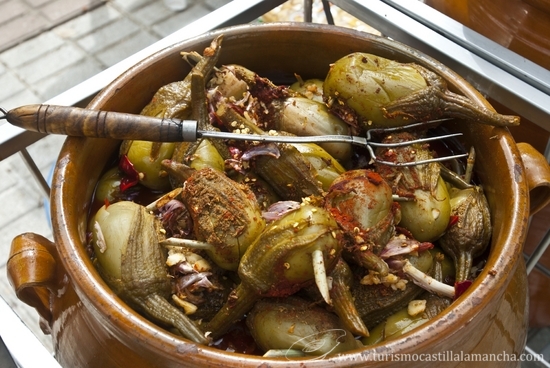
They're stuffed with other vegetables, mainly tomato, and are served with a skewer of bamboo through them to keep them together. I know, I know, they really don't look like eggplants. I'm guessing that they're baby eggplants (hence the need to pickle them). They're quite good, tasting (I know this will come as a shock) like pickled vegetables-- more like okra than pickled cucumbers, though. For those of you wondering, yes. I do get paid by the word.
After my meal of pickled eggplant, I wandered around the impressive town square, stopping in its various shops to admire the hand-sewn lace which is a traditional craft of the area. Before long, we were back on the bus, headed to our final destination for the day: Toledo. But that will have to wait for my next post...
Monday, March 21, 2011
You know I don't speak Portuguese.
Our second-to-last excursion of the semester was to Lisbon, Portugal. As usual, we met at the Sevilla Santa Justa train station bright and early to board the bus for the four-odd hour long trip across the border. Unfortunately for me, I've never been able to sleep on buses, airplanes, trains, etc. But there's a bright side to everything. In this particular case, I was awake to see the beautiful changes as we moved further and further out of Sevilla. The landscape surrounding Sevilla is charming in its own way-- semi-arid hills covered with olive trees, small towns and farms here and there, occasionally an old abandoned castle. Decidedly Spanish. But as we got closer to Portugal, the dry landscape got more green and more hilly. I would include a picture, but it was fairly cold that morning and, consequently, the windows on the bus were foggy for most of the time in Spain. They did clear up in time to see the border crossing into Portugal.
Not long after getting into the country, we stopped to eat/relax at (where else?) a truck stop. The highways here are dotted with them, all of the same company whose name I don't remember. Variety in food during long-range road travel is not one of Europe's strong points (Italy is the same way, so I'm going to judge the rest of the continent accordingly). The food is expensive and plain, and the worst coffee I've had since I've been here was at one such stop on the way to Granada. The immediate difference here, though, was that everyone spoke Portuguese.
Now, Portuguese and Spanish are very similar on paper. After learning a few key joining words, anyone who can read Spanish can make sense of Portuguese. But the accent, ah, there's the rub. Portugal Portuguese (as opposed to Brazilian Portuguese) pronounces all intra-word "s"s with a heavy, almost Eastern European-sounding "zh". For example, the word for house in Portuguese and Spanish is casa. In Spanish, you would pronounce it just the way it looks: CAH-sah. In Portuguese, it's CAH-zha. This is a small difference, but when one considers how many words have "s"s in the middle or end of them, it begins to mount. This, as well as a few other, more minor differences in pronunciation makes it sound like a mix between French and Russian (as one of my friends put it), and makes it all but unintelligible jibberish to me, even though I can understand Spanish just fine. Luckily, I had learned the most important vocabulary before the trip-- how to say cafe con leche (cafe con leite, for those wondering).
Anyway, a few hours after leaving the truckstop, we found ourselves in Lisbon. Lisbon, even at first glance, is much more colorful and topographically-varied than Sevilla. Pastel colors predominate, and the city is similar as far as hilliness to Austin. I instantly took a liking to the place. Immediately after checking into the hotel, we set off for our only required side trips of the excursion: to a Jeronomite monastery and to an old tower fortification on the Tagus River, which runs through Lisbon. The monastery was built in the 15th century, had Gothic architecture, is the home to the tomb of Vasco da Gama, etc. etc. If you'd like, you can check out the Wikipedia article about it: http://en.wikipedia.org/wiki/Mosteiro_dos_jerónimos . But I'd like to talk about a small revelation I had here.
If you read the article, you know that this place is visually and historically incredible. My reaction upon seeing it?
"Meh. Seen better."
The second this thought crossed my mind, it gave me pause. I've seen better? I thought to myself. Who the hell do I think I am? This is more impressive than any building the vast, vast majority of people will ever see. And I'm indifferent? Living in Spain, seeing spectacular architecture and history day-in and day-out numbs the senses. It skews one's perspective. But the realization of this absurd indifference made me think about just how lucky I am, and I'd like to take a paragraph or two here to reflect on it.
As far as I know, I'm the only one on either side of the family (which is extensive) to have the opportunity to study abroad for a semester in Europe. My mom, the valedictorian of a prestigious private school in Houston (which my grandparents made huge sacrifices for her to attend-- my grandparents' selflessness when it comes to their children and grandchildren could easily take up books to fully recount), never got the opportunity. My dad never got to travel much at all in the United States, much less Europe, until he married my mom. I'm not more intelligent than my dad. I certainly don't make the grades my mom did. And yet, here I am, just over halfway through a semester in Sevilla. I don't deserve this opportunity. But luckily for me, the hard work and generosity of others has made it possible for me to be here. I would be remiss if I didn't publicly thank those involved.
First and foremost, my parents have been absurdly generous throughout my entire college career, and especially so during my study abroad experience. They paid for my plane ticket to and from Sevilla, and made up the difference in fees that my scholarships didn't cover. My parents have never been rich. We've always been right smack in the middle of middle class. But they've worked hard all their lives and have made innumerable sacrifices to provide for me and my brother. I won the parent lottery, in the words of Randy Pausch. Beyond my parents, my paternal grandmother and maternal grandparents have also given generously to help me realize this opportunity. Without their help, this trip would likely have been impossible. I couldn't possibly thank my family enough.
I also need to acknowledge the generosity shown to me by Texas Tech. Through merit scholarships alone, I was able to pay for the vast majority of expenses associated with the program, which are fairly steep. One of the reasons I chose Texas Tech was the low tuition and the generous number of scholarships available. I'm not exaggerating when I say that I couldn't have made this trip without the enthusiastic support of study abroad provided by my university. But scholarships aren't won by individual people. I'd like to publicly thank those who wrote letters of recommendation for me-- Drs. Marjean Purinton and Gary Bell. They took the time out of their busy schedules to recommend me for the money that is now financing this trip. In addition, Don Harragan, president emeritus of Texas Tech, funded the Honors College Study Abroad Scholarship, which helped immensely with the cost of this semester.
For all of the above reasons, I am absurdly lucky to be here seeing the things I'm seeing. And I don't take it for granted. So, to those mentioned above who helped make this experience possible, from the bottom of my heart, thank you. Back to discussing said experience.
After seeing the evening's sights, we headed back to the hotel. A few friends and I decided to make a trip to the grocery store to get snacks and food for the next few days. In addition to the usual sandwich supplies, we bought a gallon of ice cream, some "green wine" (not green at all, as it turns out-- more like a sparkling white wine), and a nice bottle of porto. I had never tried port, and figured that if there was ever a time to give it a shot, it was in Portugal. I wasn't disappointed. Sweet, oaky, strong. Paired horribly with the ice cream. But delicious nonetheless. And what a difference a day can make! The next night, we finished the bottle. The twenty-four-odd hours spent oxidizing took the bite off the alcohol (it's a fortified wine and has an alcohol content of around 20%) and enriched the oakiness. Fantastic.
The next morning I took a bus to the other side of the river to the statue of Cristo Rei, which is a miniature of the Cristo Redentor in Brazil. Perched on a cliff high above the city, it offers incredible panoramic views.
 You may notice that the bridge in the picture looks awfully similar to the Golden Gate in San Francisco. No coincidence there; the same company that built the Golden Gate built this one. Lisbon's isn't as large as San Francisco's, but is still beautiful. Between the miniature Cristo Redentor and the miniature Golden Gate, many of us started to think that the people of Lisbon just wait for the rest of the world to do cool stuff then put smaller replicas in their own city. At any rate, it was a great view (once I got over my persistent fear of heights) certainly a worthwhile side trip. On the way back to the hotel, the bus made stops at an art museum and at Lisbon's world-famous aquarium. I opted for the aquarium.
The Lisbon Oceanarium, as I have just said, is world-famous and houses an incredible diversity of animals. Its most well-known attraction is its 180,000 cubic foot main tank, which contains approximately 100 different species of marine life. Besides the tank, they had extensive exhibits of a variety of non-water bound animals, such as PENGUINS! And they were so close you could reach out and touch them!
 And there were otters. That they were feeding by throwing bits of fish onto their bellies. Unimaginable cuteness.
I really enjoyed the aquarium. It was pricey-- fourteen euro if I remember correctly-- but worth it. Afterward, I headed back to the hotel to meet up with some friends for dinner. We went to a cheap churrascaria nearby. It definitely wasn't Fogo de Chao, but it also only cost about fifteen bucks for all you can eat meat. No, it wasn't top quality. But it was meat. And a lot of it. Can't pass it up.
The next day I had planned on taking a trip with a bunch of people from the group to the nearby town of Sintra, which apparently had a really cool castle and offered great views of Lisbon. However, plans often change. Sometimes for worse, other times for better. Still other times for fantastic. I was sitting at the breakfast buffet at the hotel with a friend of mine, Nate Covarrubias, chatting as always. He mentioned that he was waiting for a phone call from someone else regarding a trip to Fatima. I knew before the trip that Fatima was near Lisbon, but I also knew that it was too far to take a trip on my own and that no group trips had been planned. He also mentioned that someone else that had previously planned on taking the trip had decided not to go. I asked if there was any chance that I could take his place. Five minutes later, I was in a taxi and on my way. Turns out that the director of the center had organized a trip for the three people who had wanted to go and hired a taxi, writing it off as an educational expense. I was thrillled.
For those who don't know the story of Fatima, here's a brief introduction. On May 13, 1917, three children were tending sheep when they reportedly saw a woman "brighter than the sun, shedding rays of light clearer and stronger than a crystal ball filled with the most sparkling water and pierced by the burning rays of the sun"-- the Virgin Mary. She appeared again on the thirteenth day of the following two months in the same spot, and again on August 19th. These apparitions immediately became famous, and a large crowd (30,000-100,000 in size, depending on the source) gathered to witness a miracle that had been prophesied-- what became known as The Miracle of the Sun. One of the more famous aspects of the apparitions at Fatima were the three secrets supposedly bequeathed to the children by the Virgin Mary. The first two were visions of hell and admonitions to prayer. The third was kept secret until 2000-- it predicted the assassination of a pope, which was widely regarded as coming to fruition in the assassination attempt of Pope John Paul II on, interestingly, May 13th 1981 which is, of course the anniversary of the first apparition. John Paul II believed that Our Lady saved his life that day-- he later placed the bullet that struck him into the crown of the statue of Mary at the site of the apparitions-- and continued a special bond with Fatima until he died.
We chose an excellent time to visit Fatima. More correctly, we were lucky enough to get to make a trip to Fatima when we did. There was hardly anyone there (relatively speaking-- there were a few hundred people there, but the place is built to accommodate hundreds of thousands). A small, open-air altar marks the spot of the apparitions.
Fatima is an incredible place. A quiet, holy place-- quite unlike so many Marian sites that have been overrun with souvenir stands and other cheesy shops. For those interested, more pictures of my time there can be found in my album, which can be accessed here (the Fatima pictures are in the last half). It's an incredible place that really can't be captured in words.
Once we got back to Lisbon (an hour and a half drive from Fatima), a group of us set out once again, this time to wonder the streets of downtown. Walking around on cobblestone streets seems to me to nurture the soul. Even better when enjoyed with others.
 Our time in Lisbon was far too short. I could've easily spent a few weeks there and around Portugal. But I was able to cram quite a bit into the time that I had, and, on the bright side, it leaves more to be explored on my next trip.
 |
| On the left is Spain, on the right, Portugal. |
Now, Portuguese and Spanish are very similar on paper. After learning a few key joining words, anyone who can read Spanish can make sense of Portuguese. But the accent, ah, there's the rub. Portugal Portuguese (as opposed to Brazilian Portuguese) pronounces all intra-word "s"s with a heavy, almost Eastern European-sounding "zh". For example, the word for house in Portuguese and Spanish is casa. In Spanish, you would pronounce it just the way it looks: CAH-sah. In Portuguese, it's CAH-zha. This is a small difference, but when one considers how many words have "s"s in the middle or end of them, it begins to mount. This, as well as a few other, more minor differences in pronunciation makes it sound like a mix between French and Russian (as one of my friends put it), and makes it all but unintelligible jibberish to me, even though I can understand Spanish just fine. Luckily, I had learned the most important vocabulary before the trip-- how to say cafe con leche (cafe con leite, for those wondering).
Anyway, a few hours after leaving the truckstop, we found ourselves in Lisbon. Lisbon, even at first glance, is much more colorful and topographically-varied than Sevilla. Pastel colors predominate, and the city is similar as far as hilliness to Austin. I instantly took a liking to the place. Immediately after checking into the hotel, we set off for our only required side trips of the excursion: to a Jeronomite monastery and to an old tower fortification on the Tagus River, which runs through Lisbon. The monastery was built in the 15th century, had Gothic architecture, is the home to the tomb of Vasco da Gama, etc. etc. If you'd like, you can check out the Wikipedia article about it: http://en.wikipedia.org/wiki/Mosteiro_dos_jerónimos . But I'd like to talk about a small revelation I had here.
If you read the article, you know that this place is visually and historically incredible. My reaction upon seeing it?
"Meh. Seen better."
The second this thought crossed my mind, it gave me pause. I've seen better? I thought to myself. Who the hell do I think I am? This is more impressive than any building the vast, vast majority of people will ever see. And I'm indifferent? Living in Spain, seeing spectacular architecture and history day-in and day-out numbs the senses. It skews one's perspective. But the realization of this absurd indifference made me think about just how lucky I am, and I'd like to take a paragraph or two here to reflect on it.
As far as I know, I'm the only one on either side of the family (which is extensive) to have the opportunity to study abroad for a semester in Europe. My mom, the valedictorian of a prestigious private school in Houston (which my grandparents made huge sacrifices for her to attend-- my grandparents' selflessness when it comes to their children and grandchildren could easily take up books to fully recount), never got the opportunity. My dad never got to travel much at all in the United States, much less Europe, until he married my mom. I'm not more intelligent than my dad. I certainly don't make the grades my mom did. And yet, here I am, just over halfway through a semester in Sevilla. I don't deserve this opportunity. But luckily for me, the hard work and generosity of others has made it possible for me to be here. I would be remiss if I didn't publicly thank those involved.
First and foremost, my parents have been absurdly generous throughout my entire college career, and especially so during my study abroad experience. They paid for my plane ticket to and from Sevilla, and made up the difference in fees that my scholarships didn't cover. My parents have never been rich. We've always been right smack in the middle of middle class. But they've worked hard all their lives and have made innumerable sacrifices to provide for me and my brother. I won the parent lottery, in the words of Randy Pausch. Beyond my parents, my paternal grandmother and maternal grandparents have also given generously to help me realize this opportunity. Without their help, this trip would likely have been impossible. I couldn't possibly thank my family enough.
I also need to acknowledge the generosity shown to me by Texas Tech. Through merit scholarships alone, I was able to pay for the vast majority of expenses associated with the program, which are fairly steep. One of the reasons I chose Texas Tech was the low tuition and the generous number of scholarships available. I'm not exaggerating when I say that I couldn't have made this trip without the enthusiastic support of study abroad provided by my university. But scholarships aren't won by individual people. I'd like to publicly thank those who wrote letters of recommendation for me-- Drs. Marjean Purinton and Gary Bell. They took the time out of their busy schedules to recommend me for the money that is now financing this trip. In addition, Don Harragan, president emeritus of Texas Tech, funded the Honors College Study Abroad Scholarship, which helped immensely with the cost of this semester.
For all of the above reasons, I am absurdly lucky to be here seeing the things I'm seeing. And I don't take it for granted. So, to those mentioned above who helped make this experience possible, from the bottom of my heart, thank you. Back to discussing said experience.
After seeing the evening's sights, we headed back to the hotel. A few friends and I decided to make a trip to the grocery store to get snacks and food for the next few days. In addition to the usual sandwich supplies, we bought a gallon of ice cream, some "green wine" (not green at all, as it turns out-- more like a sparkling white wine), and a nice bottle of porto. I had never tried port, and figured that if there was ever a time to give it a shot, it was in Portugal. I wasn't disappointed. Sweet, oaky, strong. Paired horribly with the ice cream. But delicious nonetheless. And what a difference a day can make! The next night, we finished the bottle. The twenty-four-odd hours spent oxidizing took the bite off the alcohol (it's a fortified wine and has an alcohol content of around 20%) and enriched the oakiness. Fantastic.
The next morning I took a bus to the other side of the river to the statue of Cristo Rei, which is a miniature of the Cristo Redentor in Brazil. Perched on a cliff high above the city, it offers incredible panoramic views.

The Lisbon Oceanarium, as I have just said, is world-famous and houses an incredible diversity of animals. Its most well-known attraction is its 180,000 cubic foot main tank, which contains approximately 100 different species of marine life. Besides the tank, they had extensive exhibits of a variety of non-water bound animals, such as PENGUINS! And they were so close you could reach out and touch them!

I really enjoyed the aquarium. It was pricey-- fourteen euro if I remember correctly-- but worth it. Afterward, I headed back to the hotel to meet up with some friends for dinner. We went to a cheap churrascaria nearby. It definitely wasn't Fogo de Chao, but it also only cost about fifteen bucks for all you can eat meat. No, it wasn't top quality. But it was meat. And a lot of it. Can't pass it up.
The next day I had planned on taking a trip with a bunch of people from the group to the nearby town of Sintra, which apparently had a really cool castle and offered great views of Lisbon. However, plans often change. Sometimes for worse, other times for better. Still other times for fantastic. I was sitting at the breakfast buffet at the hotel with a friend of mine, Nate Covarrubias, chatting as always. He mentioned that he was waiting for a phone call from someone else regarding a trip to Fatima. I knew before the trip that Fatima was near Lisbon, but I also knew that it was too far to take a trip on my own and that no group trips had been planned. He also mentioned that someone else that had previously planned on taking the trip had decided not to go. I asked if there was any chance that I could take his place. Five minutes later, I was in a taxi and on my way. Turns out that the director of the center had organized a trip for the three people who had wanted to go and hired a taxi, writing it off as an educational expense. I was thrillled.
For those who don't know the story of Fatima, here's a brief introduction. On May 13, 1917, three children were tending sheep when they reportedly saw a woman "brighter than the sun, shedding rays of light clearer and stronger than a crystal ball filled with the most sparkling water and pierced by the burning rays of the sun"-- the Virgin Mary. She appeared again on the thirteenth day of the following two months in the same spot, and again on August 19th. These apparitions immediately became famous, and a large crowd (30,000-100,000 in size, depending on the source) gathered to witness a miracle that had been prophesied-- what became known as The Miracle of the Sun. One of the more famous aspects of the apparitions at Fatima were the three secrets supposedly bequeathed to the children by the Virgin Mary. The first two were visions of hell and admonitions to prayer. The third was kept secret until 2000-- it predicted the assassination of a pope, which was widely regarded as coming to fruition in the assassination attempt of Pope John Paul II on, interestingly, May 13th 1981 which is, of course the anniversary of the first apparition. John Paul II believed that Our Lady saved his life that day-- he later placed the bullet that struck him into the crown of the statue of Mary at the site of the apparitions-- and continued a special bond with Fatima until he died.
We chose an excellent time to visit Fatima. More correctly, we were lucky enough to get to make a trip to Fatima when we did. There was hardly anyone there (relatively speaking-- there were a few hundred people there, but the place is built to accommodate hundreds of thousands). A small, open-air altar marks the spot of the apparitions.
 |
| Behind the bishop saying mass is the statue of Our Lady wearing the crown that contains the bullet that struck Pope John Paul II. The people pictured are members of the Portuguese army. |
Once we got back to Lisbon (an hour and a half drive from Fatima), a group of us set out once again, this time to wonder the streets of downtown. Walking around on cobblestone streets seems to me to nurture the soul. Even better when enjoyed with others.

Saturday, March 12, 2011
On the difficulty of securing an internship
You might get the impression from my previous posts that all I’m doing in Spain is eating and traveling. While those are my most enjoyable endeavors, I’m also enrolled in the last twelve hours of coursework required for my Spanish degree. Now, my college friends might point out that twelve hours is hardly a heavy load, and they’d be right. But no matter how little, any time spent in the classroom feels like it drags on forever because, well, I’m in Spain and I’d rather be leisurely sipping a café con leche and reading a book. Luckily, that’s exactly what one of my classes, an independent study in literature, entails. Instead of having lectures, my professor and I choose works for me to read, set deadlines, and meet periodically to discuss them. Thus, while my friends here in Sevilla have class from 9-12 each morning (two classes back-to-back), I have lecture from 9-10:20 (a course called Spanish life and culture) and I’m finished with my classroom time for the day. After the first class, I go to my favorite bar to have breakfast and read.
Now, before we go any further, I need to explain the difference between a bar in the United States and the typical bar in Spain. While there certainly are American-style, only-for-drinking-at-night bars here in Sevilla, the majority are quiet, family-run cafes that specialize in breakfast and tapas. Imagine if Starbucks also sold alcohol and you’d be on the right track.
Anyway, I go to a particular bar, Café d’Arthe, which is right around the corner from the school. It has the best, cheapest breakfast and café con leche and the friendliest workers in the city. It offers the perfect atmosphere for reading. It’s the best classroom I’ve ever had at Tech.
Alas, not all of my classes are so leisurely. I’m taking four classes this semester. The semester here is broken into two halves, which would ordinarily mean that I would take two classes for the first half and two for the second. I finished with one of my classes last half and am now taking another half-semester course. The other two classes span the regular semester: my independent literature course that I mentioned above, and a class called “The internship in Spanish.” The point of this class, as the name suggests, is to secure and internship with a local business and work 70 hours total over the course of the semester, with various side assignments (such as writing an essay over a labor issue in Spain).
So, in January when classes started, I started looking into options. Luckily, the Center keeps logs of the places where previous students have worked and have them filed according to category (social work, restaurants, gyms, etc.). One of the suggestions from the professor was to work at one of the local nursing homes, which, she said, had been a really good experience for previous students. The idea of sitting around chatting with old people, many of whom lived through not only the Franco era, but the Civil War itself, sounded charming. I got the information for a nearby Church-run nursing home and, a few weeks later, stopped by and asked for the director. After waiting for a short time, two nuns, one old, the other older, came in to greet me. I introduced myself as a student from the university and told them that I was interested in doing an internship with them, as students had done in the past. To my dismay, however, they told me that they had decided not to take on any students for this semester. They were very sweet and had a good reason for doing so—they said that many of the people at this particular nursing home were in a far too-advanced state to be able to hold any meaningful conversation, which would mean that any students interning there would have only minimal opportunities to improve their language skills. Fair enough, I thought, and I thanked them for their time and left.
Despite this setback, I really wasn’t concerned about the situation. I figured there were plenty of other opportunities to work in nursing homes. There weren’t. That particular home was the only one on file, so I had to figure something else out. Unlike most of the other people in the class, I’m not a business or business-related major. So I wasn’t all that interested in getting a desk job here in Sevilla. After reviewing my remaining options, I found a promising opportunity at the offices of an association for developmental disorders. They’d taken students before, and I figured it would be a great place to practice my Spanish while doing medically-related and meaningful work. I stopped by that very same day—we’re now in the third week of January—to talk with the director about an internship. She wasn’t there, but the office secretary was very friendly and let me know that she’d be in later that week and, if I wanted, I could leave a resume and contact information to be passed on. I wrote a brief letter describing what I was looking for and jotted down a resume. The secretary told me that I’d probably hear something by week’s end. This was on a Monday.
The following Tuesday (that is, a week and a day after I first dropped by), after not having heard anything, I returned to the office to again try to talk with the director. She wasn’t there, but the secretary told me that she would be in on Thursday. I returned on Thursday to an empty office. The following week I returned, to be told that the director would certainly be there the next week and, if I would like, the secretary would set up a time specifically for me in the director’s schedule. I came back the next week ten minutes before my scheduled meeting. After waiting there for two hours, the secretary called the director to ask her where she was. The director, she told me, had something else that had come up and wouldn’t be able to meet with me today. I thanked them for their time, told them I’d be in touch, and left.
Beginning to feel the pressure—it was now February and I was the only one that hadn’t started working yet—I asked around for other options. One of the associate directors at the Center told me that there was another nursing home close by that a student had worked at the year before but, for some reason, hadn’t been documented in the log of previous businesses (hence my not knowing about it). Encouraged, I went by there that very same day. Only to be told that the director wasn’t there, but, if I would like, I could return the next day to meet with him. Being a “director” must be the best job in all of Spain. From what I can tell, it basically means that you never, ever have to come to work. Quickly seeing where this was headed, I thanked them and left with no intentions of coming back. I didn’t have another month to waste waiting for a meeting with someone who may or may not actually exist.
Now beginning to get nervous, I returned to the Center to ask if they had any other ideas. “How do you feel about working in a restaurant?” they asked me. I sighed. My first and only experience in the food service industry, a three month stint at Sonic in high school, had left me prematurely jaded. But I was out of options. However, when they told me that Café d’Arthe, at which I had become a regular, positively loved having students and were somewhat disappointed that none had applied, my disappointment turned to excitement. Spaniards spend half their lives in bars (remember, think coffee shop rather than Moe’s), they say. They’re sort of like the roadside diners in the country, or the barbershops in Harlem. Bars are where Spaniards go to shoot the breeze with their neighbors and friends. They’re the social hubs of the country.
The owners of the bar, whom I had gotten to know over the previous month, were happy to have me joining them. I learned to make coffee and pour beer and that was that. If only I had gone to them first, I would’ve saved nearly a month and a half of walking around the city for canceled meetings with non-existent “directors”.
In addition to satisfying the requirements for the course, working at the bar is a lot of fun. There are two owners, Eva and Jairo, and another employee named Mauricio. Eva is from Columbia, Jairo, her husband, is from Venezuela, and Mauricio, Uruguay. Nicest people you’d ever met. And so generous, too. In addition to getting most of my breakfasts for free these days, Eva and Jairo will encourage me to have a second breakfast or, if I go too long without my treasured café con leche, Jairo will tell me to make one for myself, in the same imperative manner in which a father might tell his kid to go mow the lawn. What can I say? They simply insist on giving me free coffee. And of course I don’t want to offend them, so I do as they say and make myself another delicious, creamy, rich, steaming cup of deliciousness. It’s tough work, but someone’s gotta do it.

Subscribe to:
Posts (Atom)